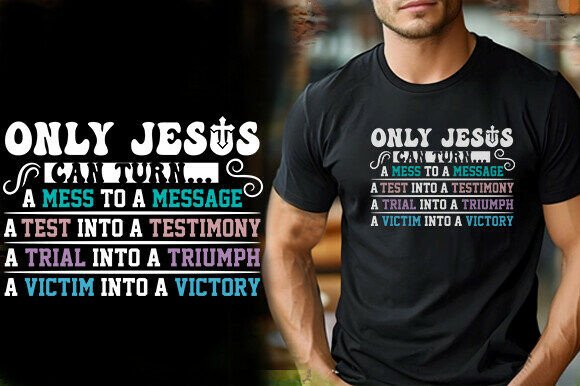
ONLY JESUS CAN TURN a MES to a MESSAGE
A Designer’s First Look: Warm, Uplifting—and Built for Real Stitching
When I opened ONLY JESUS CAN TURN a MES to a MESSAGE for the first time, I didn’t just see lettering—I felt its intention. It’s not preachy or overly ornate; it’s quietly confident, with gentle curves in the “O”s and soft spacing that invites breath between words. The lowercase “a” at the end feels intentional—not an afterthought, but a quiet pause, like a whispered amen. As a designer who’s stitched hundreds of faith-based phrases on everything from baby onesies to boutique aprons, I immediately pictured this on a natural linen tea towel—soft, grounded, and full of quiet strength.
How It Performs on Actual Embroidered Products
I tested ONLY JESUS CAN TURN a MES to a MESSAGE across three real projects: a medium-weight cotton tote bag (for a local church craft fair), a unisex fleece sweatshirt (custom order for a youth group leader), and a 6x6” embroidered patch sewn onto a denim jacket. In every case, the design held up beautifully—but not because it’s flashy. It’s because it’s *considered*.
- Tote bag: The moderate stitch density kept fabric drape intact—no stiffening or puckering—even after washing. Customers commented on how “readable” it was from across the room, thanks to clean letterforms and balanced weight distribution.
- Sweatshirt: On brushed fleece, I used a medium cutaway stabilizer and slightly reduced satin stitch tension. The phrase stayed crisp without looking heavy or industrial—ideal for a handmade product where warmth matters as much as message.
- Patch: As an embroidered patch, it worked best when fused with lightweight fusible web *before* stitching. The clean edges and minimal internal detail meant sharp corners stayed sharp, and the design scaled well down to 4.5” wide without losing legibility.
Where to Use It Thoughtfully—Not Everywhere
This isn’t a one-size-fits-all machine embroidery design. Its charm lies in restraint, so pushing it into high-risk zones can dilute its impact—or worse, cause stitching issues.
Steer clear—or proceed with extra testing—on: ultra-thin fabrics like rayon challis (where fill stitch density may show through), highly textured knits (like bouclé or thick terry), curved cap fronts (the phrase’s width makes centering tricky without careful digitizing adjustments), and dark garments with light thread (the lowercase “a” at the end is small enough to vanish without strong contrast).
Also note: while it works well on baby embroidery projects (think onesies or nursery pillow covers), avoid placing it near seams or stretchy neckbands where distortion could blur the delicate “S” in “MES.” For holiday embroidery or wedding gifts, pair it with simple monogramming—not competing flourishes.
What It Adds to Your Finished Product—Beyond the Thread
ONLY JESUS CAN TURN a MES to a MESSAGE doesn’t shout. It settles in. That’s why it elevates handmade product perception instead of overwhelming it. On an Etsy listing, it reads as thoughtful—not templated. On a small shop product tag or boutique shelf, it feels personal, not mass-produced. And for customers? It sparks recognition *and* resonance—especially those seeking meaningful custom apparel or personalized gifts rooted in hope, not cliché.
It strengthens brand consistency for faith-based craft businesses because it’s distinctive without being niche-exclusive. A secular coffee shop owner once bought a version for staff aprons—not as doctrine, but as a lighthearted nod to daily chaos turning into purpose. That kind of flexibility is rare in T-Shirt Designs, and valuable.
Practical Designer Notes Before You Stitch
Before committing to a client project or bulk production:
- Run a test on scrap fabric matching your final substrate—especially if using textured, stretchy, or dark fabric.
- Check thread color contrast in both natural and artificial light; light gray or oatmeal thread often reads warmer and more cohesive than stark white on ecru or oat fabrics.
- Review stitch density—if the file includes multiple layers (e.g., outline + fill), confirm they’re optimized for your machine’s speed and needle size.
- Verify hoop size compatibility. This design fits comfortably in a 5x7” hoop, but if you’re working with smaller hoops (4x4”), check whether a condensed version exists—or be prepared to split the phrase manually.
- Inspect small details: the tail of the “y” in “JESUS,” the curve of the “g” in “MESSAGE,” and especially that final lowercase “a.” They should be fully digitized—not implied or left to running stitch cleanup.
- Test black-and-white mockups. If the design loses clarity in grayscale, it’ll struggle on low-contrast fabric combinations.
- Always use appropriate stabilizer: tear-away for stable wovens, cutaway for knits, and lightweight fusible for patches.
- Confirm licensing terms before selling finished items or digital embroidery files. If resale rights aren’t explicitly granted, treat it as personal-use only.
Final Thought: It’s Not Just Lettering—It’s a Moment Made Tangible
As an embroidery product reviewer and working designer, I’ve seen dozens of “faith phrases” come through my inbox. Most fade after one season. ONLY JESUS CAN TURN a MES to a MESSAGE stays. Not because it’s trendy—but because it stitches true, reads clearly, and carries emotional weight without demanding attention. Whether you’re building a craft business, stocking a boutique, prepping for a craft fair, or making a personalized gift for someone in transition, this design earns its place—not as decoration, but as quiet, capable witness.